
Introduction
While most F&I offices focus heavily on product pricing and presentation, a compliance risk is embedded in every retail installment contract signed on your lot: the FTC Holder Rule. This 1975 regulation embeds legal liability directly into the contract itself, creating exposure that flows not just to your dealership, but to every finance company that purchases the paper. Recent regulatory shifts (especially the FTC's 2022 reversal on attorneys' fees) have made this risk much harder to contain.
Many dealers struggle to understand how the Holder Rule applies to their daily operations, particularly as enforcement priorities shift and case law evolves. This guide covers what the rule requires, who it applies to, what changed in 2022, how it intersects with the now-vacated FTC CARS Rule, and the steps your F&I office can take to reduce exposure before a dispute becomes a legal liability.
TLDR:
- The FTC Holder Rule requires a specific notice in every consumer credit contract, making lenders liable for dealer misconduct
- Missing the notice is a standalone violation, regardless of whether a consumer dispute exists
- The 2022 FTC guidance allows attorneys' fees beyond the traditional payment cap, dramatically expanding liability
- Compliance spans contract templates, F&I product presentation, and documentation practices
What Is the FTC Holder Rule?
The FTC Holder Rule (16 CFR Part 433), enacted in 1975, requires a specific FTC-mandated notice be embedded in every consumer credit contract—including retail installment sales contracts (RISCs)—used to finance the purchase of goods or services through third-party financing.
The Required Notice Language
The notice must appear verbatim in at least 10-point bold type on the face of the contract:
NOTICE
ANY HOLDER OF THIS CONSUMER CREDIT CONTRACT IS SUBJECT TO ALL CLAIMS AND DEFENSES WHICH THE DEBTOR COULD ASSERT AGAINST THE SELLER OF GOODS OR SERVICES OBTAINED PURSUANT HERETO OR WITH THE PROCEEDS HEREOF. RECOVERY HEREUNDER BY THE DEBTOR SHALL NOT EXCEED AMOUNTS PAID BY THE DEBTOR HEREUNDER.
Failure to include this language in the correct format and placement is itself a compliance violation under Section 5 of the FTC Act, regardless of whether any consumer claim ever arises.
Purpose and Original Recovery Cap
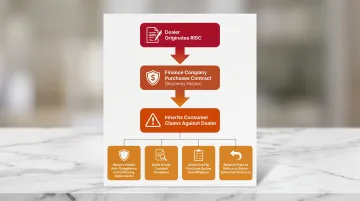
Before 1975, lenders who purchased consumer credit contracts could claim "holder in due course" status—effectively shielding themselves from any claims a consumer had against the original seller. The Holder Rule eliminated that shield, ensuring that when a seller's misconduct caused harm, consumers retained recourse against whoever held the financing contract.
Under the rule's original interpretation, consumer recovery was capped at amounts already paid under the contract. If a buyer had paid $2,000 on a $35,000 note, their maximum recovery was $2,000—regardless of the underlying harm. That ceiling gave dealers and finance companies a defined, predictable limit on exposure.
Who Does the FTC Holder Rule Apply To?
Franchise, Independent, and Retail Dealers
Any dealer who sells vehicles on credit and assigns those contracts to a third-party finance company must include the Holder Notice. This applies to:
- Franchise new car dealers
- Independent used car dealers
- Retail dealers of all sizes
Omission of the notice constitutes an unfair or deceptive practice and creates immediate compliance exposure.
Buy Here Pay Here (BHPH) Dealers
BHPH dealers face a tighter compliance risk because they both originate and retain their own contracts. As seller and holder simultaneously, all consumer claims against the dealership stay with the dealership directly. There is no assignment to a third party that might absorb or limit that exposure. This makes point-of-sale compliance especially critical.
How Liability Flows to Finance Companies
For dealers who do assign contracts, the liability picture shifts — but doesn't disappear. Once a bank, credit union, or finance company purchases a RISC from a dealer, it becomes a "holder" and inherits whatever claims the consumer had against the original dealer. This is why lenders increasingly:
- Require Holder Rule compliance as a condition of purchasing agreements
- Audit dealer contract templates before buying paper
- Scrutinize dealer F&I practices during due diligence
- Reserve the right to refuse or return contracts with compliance defects
The 2022 Shift: Attorneys' Fees and Expanding Liability
The Traditional Interpretation (Pre-2022)
For decades, the FTC maintained that recovery under the Holder Rule was capped at what the consumer had paid. This interpretation provided a predictable, manageable liability framework. A consumer who paid $1,500 on a $40,000 contract could recover no more than $1,500, even if the dealer's misconduct caused greater harm.
The FTC's 2022 Reversal
In January 2022, the FTC issued a Commission Statement reversing its prior guidance. The agency announced that attorneys' fees and costs could be recoverable above and beyond the payment cap when authorized by state or federal law. The cap, the FTC clarified, applies only to the underlying recovery for seller misconduct—not to independently authorized fees.
The California Supreme Court's Pulliam Decision
That regulatory shift was quickly tested in court. The California Supreme Court's ruling in Pulliam v. HNL Automotive, Inc. (May 26, 2022) confirmed the FTC's position, holding that the Holder Rule's "amounts paid" cap does not bar an award of attorneys' fees under a state prevailing-party statute.
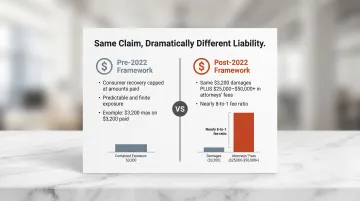
In Pulliam, the jury awarded approximately $21,957 in damages, but the plaintiff recovered $169,602 in attorneys' fees under California's Song-Beverly Consumer Warranty Act. That nearly 8-to-1 ratio shows how a small-dollar claim can generate serious liability once legal fees enter the picture.
Practical Risk Illustration
Consider a consumer who finances a $32,000 vehicle and pays $3,200 over six months before discovering that the GAP coverage they purchased duplicates their existing insurance.
Under the traditional interpretation, maximum exposure was $3,200. Under the post-2022 framework, that same consumer could recover:
- $3,200 in damages (amounts paid)
- $25,000–$50,000+ in attorneys' fees (depending on state law and case complexity)
Minor F&I compliance failures now carry major financial exposure. That liability extends to both the dealer and the finance company holding the contract, making thorough documentation and disclosure practices a front-line defense.
Practical Compliance Steps for Your F&I Office
1. Audit Your Contract Templates Immediately
Confirm that every RISC your dealership uses includes the required FTC Holder Notice in:
- Correct language (verbatim from 16 CFR 433.2)
- Correct format (at least 10-point bold type)
- Correct placement (on the face of the contract)
Missing or defective notices expose you to a standalone violation before any consumer dispute arises.
2. Build Complete and Organized Deal Jackets
Document every aspect of the transaction:
- All disclosures provided
- Add-on products presented and explained
- Consents obtained (express and written)
- Pricing discussed and agreed upon
- All forms signed by the customer
If a consumer dispute escalates, the deal jacket is the primary record used to assess whether your dealership acted in compliance. Incomplete or disorganized files make defense difficult and expensive.
3. Establish a Formal Customer Complaint Process
Every complaint should be:
- Logged with date, customer name, and issue summary
- Reviewed by management or compliance staff
- Responded to with a documented record of resolution or escalation
Ignored or mishandled complaints are the most common trigger for enforcement attention and lender scrutiny. Under the post-2022 framework, every complaint is a potential test of liability.
4. Train F&I Staff on Prohibited Practices
Focus training on behaviors that generate consumer claims:
- Misrepresentations about pricing or financing terms
- Add-on products that provide no genuine benefit
- Undisclosed fees or charges
- Failure to obtain express informed consent
These dealer-side practices create the underlying claims that attach to the contract and flow to the holder.
5. Structure Add-On Products to Genuinely Benefit the Consumer
Training addresses prohibited behaviors, but product structuring is where claims originate. Every warranty, vehicle service contract (VSC), GAP agreement, or ancillary product should meet four tests before it's presented:
- Coverage applies to the actual make, model, and mileage — not just the product category
- It addresses a real risk for that specific customer, not a generic sales scenario
- It doesn't duplicate existing coverage the customer already holds
- The customer understands exactly what they're buying and what it costs
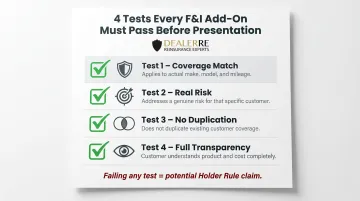
Products that fail these tests are both a CARS Rule violation and a direct source of Holder Rule claims.
How DealerRE Supports Compliance:
Partners like DealerRE help dealers structure compliant, properly administered F&I products through dealer-owned reinsurance programs. DealerRE manages all legal forms, filings, and compliance documentation, which reduces Holder Rule exposure at the product level — where it originates. Their administration model covers training, claims adjudication, and performance oversight, ensuring products deliver benefits consumers can actually use.
How the Holder Rule Intersects with the FTC CARS Rule
What the CARS Rule Codified
The FTC's Combating Auto Retail Scams Rule (CARS Rule), finalized in January 2024, codified prohibitions on misrepresentations across 16 categories, including:
- Costs or terms of purchasing, financing, or leasing
- Any aspect of add-on products or services
- Whether financing or lease terms are final or binding
- Availability of vehicles at advertised prices
- Government affiliation or endorsement claims
The rule also required disclosure of the offering price, add-on optionality, and express informed consent before charging.
Current Legal Status
On January 27, 2025, the Fifth Circuit vacated the CARS Rule on procedural grounds. However, the FTC's underlying authority under Section 5 of the FTC Act and the Holder Rule itself remain fully in effect and enforceable.
The Critical Intersection: No Safe Harbor
During the CARS Rule rulemaking, industry associations requested a safe harbor insulating finance companies from Holder Rule exposure for dealer violations. The FTC explicitly declined, stating the rule would not create assignee liability where none previously existed under the Holder Rule—but it would not eliminate existing exposure either. Finance companies that purchase RISCs remain on the hook for dealer violations even under a rule technically aimed at dealers alone.
Compliance as Risk Management
That assignee exposure is what makes F&I compliance a direct risk management issue, not just a regulatory checkbox. The violations that generate Holder Rule claims are precisely the behaviors the CARS Rule was designed to prohibit—meaning a transparent, well-documented F&I office reduces both types of exposure at once:
- Misrepresentations about cost or terms
- Add-ons with no consumer benefit
- Undisclosed fees
- Failure to obtain informed consent
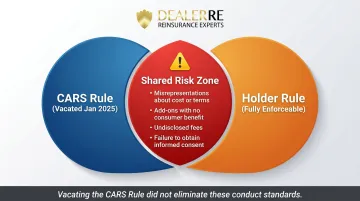
The CARS Rule may be vacated, but the conduct standards it codified remain the clearest benchmark for what regulators—and plaintiffs' attorneys—consider acceptable F&I practice.
Frequently Asked Questions
What is the FTC Holder Rule for auto dealers?
The Holder Rule (16 CFR Part 433) requires a specific notice in every consumer credit contract stating that the contract's holder is subject to all claims the consumer could bring against the original seller. This preserves consumers' legal rights even after the contract is sold to a lender.
What notice language does the FTC Holder Rule require on contracts?
The required notice states: "ANY HOLDER OF THIS CONSUMER CREDIT CONTRACT IS SUBJECT TO ALL CLAIMS AND DEFENSES WHICH THE DEBTOR COULD ASSERT AGAINST THE SELLER..." It must appear in at least 10-point bold type on the face of the retail installment sales contract.
Does the FTC Holder Rule apply to Buy Here Pay Here dealers?
Yes. BHPH dealers are both seller and holder of their own contracts, so all consumer claims remain with the dealership directly. This makes compliance at the point of sale especially critical, as there is no third-party lender to share or absorb exposure.
What changed about the FTC Holder Rule and attorneys' fees in 2022?
The FTC reversed its prior guidance and signaled that attorneys' fees could be recoverable beyond the original payment cap. This shift was reinforced by the California Supreme Court's Pulliam decision, which significantly expanded potential liability for both dealers and finance companies.
How does the Holder Rule interact with the FTC CARS Rule?
The FTC declined to create a safe harbor from Holder Rule liability for CARS Rule violations, meaning lenders who purchase RISCs can still be held liable for a dealer's CARS Rule-related misconduct. This gives finance companies strong incentive to enforce dealer compliance.
Can a finance company be held liable for a dealer's F&I violations under the Holder Rule?
Yes. Once a finance company purchases a retail installment contract, it becomes a holder and inherits any claims the consumer had against the original dealer. That inherited liability is why lenders increasingly scrutinize dealer compliance practices before purchasing contracts.