
Introduction
Every BHPH dealer knows the problem: you finance a vehicle, require full-coverage insurance as a condition of the loan, and then discover weeks or months later that the customer let the policy lapse. Now your collateral sits unprotected, and if that car is totaled in an accident or stolen, you're staring at a total loss with no insurance recovery and a customer who still owes the full balance.
Collateral Protection Insurance (CPI) is the industry-standard solution to this risk — but setting it up correctly requires more than signing up with a vendor. You need to understand the mechanics, choose the right participation structure, update your contracts, and train your staff.
Many BHPH dealers skip CPI entirely or implement it in ways that create compliance exposure or leave profit behind. This guide covers the full setup process:
- How CPI mechanics work and what program parameters to define
- How to choose the right participation structure for your operation
- What contract language and disclosure requirements to have in place
- How to build customer communication workflows that keep you protected
Key Takeaways
- CPI protects your dealership when a customer lets insurance lapse — you purchase coverage on the collateral and pass the cost to the customer
- As a commercial insurance product between the dealer and carrier, CPI sits outside consumer insurance regulations — though state treatment varies
- Participation structures include retro advance, retrospective commission, or dealer-owned reinsurance, each offering different levels of profit potential
- Setup requires contract updates, provider selection, insurance monitoring, and staff training
- A well-run CPI program improves cash flow, reduces total-loss exposure, and creates a durable revenue stream for your dealership
What Is CPI and Why Every BHPH Dealer Needs It
Collateral Protection Insurance is a single-interest insurance product purchased by the creditor (the dealer) to protect the financed vehicle when the customer fails to maintain required physical damage coverage. It's a safety net that keeps your collateral covered even when a customer lets their policy lapse.
This is a particularly persistent problem in the BHPH space. Your customers typically have poor credit, tight budgets, and limited insurance options. Drivers with poor credit pay an average of $395 per month for full-coverage auto insurance , nearly double the national average for drivers with good credit. When faced with that kind of premium, many customers simply stop paying, cancel coverage, or let policies lapse without telling you.
The BHPH Insurance Problem
Most BHPH credit agreements require the buyer to carry comprehensive and collision coverage with the dealer named as loss payee. But enforcing this requirement is operationally difficult:
- Customers cancel coverage after signing without notifying you
- They switch carriers and don't provide updated declarations
- They stop paying premiums and coverage lapses mid-term
- Some never obtain coverage in the first place
If an uninsured vehicle is totaled or stolen, you lose both the collateral and the remaining loan balance with zero recovery. Industry data shows that more than 50% of BHPH installment contracts do not pay out, and uninsured collateral losses are a major driver of those charge-offs.
That's exactly the gap CPI is designed to close.
What CPI Actually Covers (and What It Doesn't)
CPI is "single-interest" coverage: only the creditor's interest in the vehicle is insured. The customer is not covered for:
- Liability to third parties
- State minimum insurance requirements
- Their own medical expenses or personal property
- Their own financial loss in an accident
CPI does not replace the customer's own auto insurance policy. Dealers should communicate this clearly at the point of sale to avoid confusion.
It's also worth distinguishing CPI from two related products. GAP insurance covers the difference between a vehicle's actual cash value and the outstanding loan balance after a total loss. Vendor Single Interest (VSI) insurance is a similar creditor-placed product, but it's structured differently and typically used by lenders who don't service their own loans.
How a CPI Program Works at a BHPH Dealership
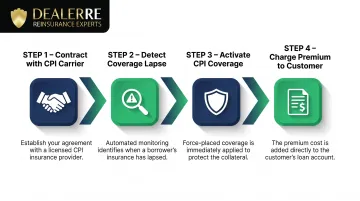
The operational sequence is straightforward:
- Contract with a CPI carrier to establish your program terms
- Detect a lapse or inadequate coverage in your active portfolio
- Activate CPI coverage on the affected vehicle
- Charge the premium back to the customer — either added to their loan balance or billed as a separate line on their payment schedule
Monthly Premium Collection
Unlike traditional bank programs that required fronting a full year's premium upfront, modern CPI programs let you pay premiums monthly as you collect from the customer. This eliminates the negative cash flow problem that historically kept smaller BHPH dealers from participating — you're not out of pocket waiting for reimbursement.
Insurance Status Monitoring
You — or your CPI provider — track coverage across your active portfolio through:
- Customer-submitted declarations pages
- Automated insurance verification services
- DMS integrations that flag lapsed or missing coverage
When a lapse is detected, you trigger enrollment according to your internal rules — typically 15 to 30 days after the lapse date, depending on your contract language and state requirements.
What to Expect in Year One
Penetration rates vary, but dealers who enforce monitoring consistently often see 20–40% of their active portfolio enrolled within the first 12 months. The difference between a productive program and a stagnant one usually comes down to enrollment timing — the faster you act on a detected lapse, the more coverage gaps you close.
How to Set Up a CPI Program: A Step-by-Step Guide
Setting up CPI isn't a single event — it's a structured process requiring decisions at the legal, operational, and financial levels before you enroll the first vehicle.
Step 1: Assess Your Portfolio and Define Program Parameters
Start by reviewing your active loan portfolio:
- How many accounts are currently active?
- What is the average loan balance?
- What percentage are uninsured or underinsured?
This data shapes which CPI product tier and premium structure makes sense for your dealership's size. A 50-unit lot with $8,000 average balances will have different needs than a 200-unit operation financing $15,000 cars.
Step 2: Choose a CPI Provider and Decide on Your Participation Structure
Not all CPI providers offer the same program structures or dealer participation options. Evaluate providers based on:
- Monthly payment flexibility — avoid programs that require large upfront capital
- Available participation models — retro advance, standard retro, or reinsurance
- Carrier AM Best rating — A-rated carriers provide stability and claims-paying ability
- Claims handling reputation — slow claims processing defeats the purpose of coverage
Working with an experienced F&I and reinsurance partner like DealerRE can simplify this vetting process and help you identify the structure that best fits your volume and long-term profit goals.
Step 3: Update Credit Agreements and Customer Disclosure Documents
Before enrolling a single vehicle, ensure your retail installment contract or BHPH credit agreement includes:
- A properly worded insurance requirement clause specifying comprehensive and collision coverage
- A CPI disclosure — clearly stating your right to purchase CPI at the customer's expense if their insurance lapses
The language must comply with applicable state finance code requirements. Have legal counsel review and update your contracts before launching — there's no workaround on this step.
Step 4: Build an Insurance Monitoring and Enrollment Process
With contracts updated, you need two core operational workflows:
1. Tracking insurance status across your active portfolio on an ongoing basis:
- Manual tracking (customer-submitted declarations every 30-60 days)
- Third-party insurance tracking services (automated verification)
- DMS-integrated tools that flag lapses in real time
2. Defined enrollment workflow — clear internal rules for when to activate CPI:
- How many days after a lapse do you trigger enrollment?
- Who is responsible for verifying lapse vs. coverage gap?
- What documentation is required before activation?
Consistency is critical. You can't enroll some customers immediately and ignore others for months. Uneven enforcement creates compliance exposure and fair lending risk.
Step 5: Train Staff and Establish Customer Communication Protocols
Once your workflows are in place, front-line staff — F&I managers, collectors, customer service — need to understand how to explain CPI to customers. Key training points:
- CPI is not a penalty — it's protection the dealer is required to maintain on the collateral
- The customer can exit it at any time by providing proof of qualifying insurance
- CPI is more expensive than personal coverage — encourage customers to reinstate their own policy
Handled well, this conversation can strengthen customer relationships. Position it as: "We noticed your insurance lapsed. We had to place coverage to protect the vehicle, but we'd much rather you carry your own policy. Here's what you need to provide to get this removed."
CPI Participation Structures: Retro Advance, Standard Retro, or Dealer-Owned Reinsurance
There are three main ways BHPH dealers can participate in CPI underwriting profit:
1. Retro Advance — The provider advances a retrospective commission to the dealer upfront with no ongoing profit share. This gives you immediate cash but caps your total profit.
2. Standard Retrospective Commission — You receive a share of underwriting profit after claims are settled, typically on an annual basis. Payout depends on loss ratios and program performance.
3. Dealer-Owned Reinsurance (Admin Obligor) — You establish your own reinsurance company and are credited a portion of each monthly premium directly. This gives you the most control and the highest profit potential.
Of the three, dealer-owned reinsurance delivers the most financial upside. In an admin obligor arrangement — DealerRE's specialty — your reinsurance company is backed by an A-rated carrier. Premiums flow into a dealer-controlled account, and you capture the underwriting profit that would otherwise go to a third-party insurer. You can reinvest or deploy those funds at your discretion, within the terms of your trust agreement.
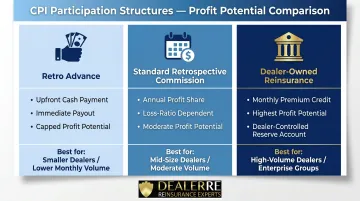
Which structure fits depends on your volume. Smaller dealers often start with a retro advance for simplicity and predictable cash flow. Larger dealers collecting $20,000 to $50,000 per month in CPI premiums typically see the strongest case for reinsurance — the underwriting profit compounds fast at that scale.
Common Misconceptions and Compliance Considerations
Misconception #1: Dealers Can Self-Insure a CPI-Style Program
This is an unlicensed insurance transaction in every state and exposes you to serious regulatory and legal liability. You cannot self-insure a risk and call it CPI — you must contract with a licensed insurance carrier. Contractual liability policies or "mechanical breakdown coverage" do not solve this problem.
Misconception #2: CPI Is Heavily Regulated as Consumer Insurance in All States
Not quite. CPI is largely a commercial insurance product between creditor and carrier, but regulatory treatment varies by state. The NAIC Creditor-Placed Insurance Model Act has been adopted in 12 states, including Arkansas, Illinois, Michigan, New Jersey, Oregon, Texas, and Washington.
Roughly 3 states regulate CPI under their insurance codes; approximately 8 regulate it through finance codes. Confirm your state's requirements before launching, and get legal review of your credit agreement language.
Misconception #3: CPI Only Works for Large Dealerships
The monthly payment model and flexible participation structures make CPI viable even for small independent BHPH dealers with modest portfolios. You don't need 500 active contracts to benefit — a well-managed program can reduce charge-offs and generate profit even at smaller scale, provided you choose the right structure and provider.
Misconception #4: Once Activated, CPI Stays in Place Permanently
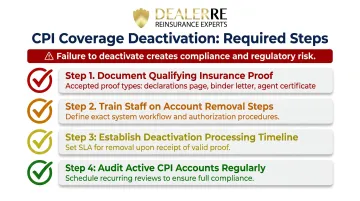
Wrong — CPI must be deactivated as soon as the customer provides proof of qualifying insurance. Failure to deactivate creates compliance exposure, regulatory risk, and damages customer trust. Your workflows must be clearly defined from day one:
- Document which insurance proof types qualify for deactivation
- Train staff on the exact steps to remove CPI from an account
- Establish a timeline for processing deactivation requests
- Audit active CPI accounts regularly to catch missed deactivations
Frequently Asked Questions
What is CPI collateral protection insurance?
CPI is a single-interest insurance product purchased by the lender or dealer to protect the financed vehicle when the buyer fails to maintain required auto insurance. The cost is passed to the customer but the policy does not replace their own liability coverage or state-required insurance.
Who pays insurance for collateral?
The dealer purchases the CPI policy directly from a licensed carrier, then passes the premium cost to the customer by adding it to their loan balance or billing it as a separate side note. The customer ultimately bears the cost but is not the policyholder.
Is collateral protection insurance legal?
Yes. CPI is legal in all states, grounded in the creditor's contractual right to require insurance on financed collateral and purchase it at the borrower's expense if they default on that obligation. Disclosure requirements and finance code compliance rules vary by state.
Can a small BHPH dealer set up a CPI program?
Yes. CPI programs are available to dealerships of all sizes. The monthly premium collection model eliminates the need to front a year of premiums, and smaller dealers can start with a simpler retro advance structure before considering a reinsurance program as their portfolio grows.
Does CPI replace the customer's regular car insurance?
No. CPI only protects the dealer's interest in the vehicle. The customer is still responsible for maintaining their own liability coverage to comply with state law and should be encouraged to reinstate their personal policy as soon as a lapse is identified.
What is the difference between CPI and a dealer-owned reinsurance program?
CPI is the insurance product itself. A dealer-owned reinsurance program is a participation structure that lets you capture the underwriting profits from CPI premiums instead of leaving them with a third-party carrier. Reinsurance is the most profitable way for a BHPH dealer to participate in a CPI program.
Ready to protect your collateral and capture CPI profits? DealerRE helps BHPH dealers nationwide set up and manage dealer-owned reinsurance programs that turn CPI from an expense into a revenue stream. Contact DealerRE at (804) 824-9533 for a consultation and portfolio analysis.